

Millions of people around the world train for a marathon. Yet only a small percentage actually reach their goal time or manage to improve consistently over the years. Why is that? A study published in the journal Sports Medicine in 2025 offers new, data-driven answers. It analyzed the training sessions of more than 119,000 runners in the 16 weeks leading up to their races.
The central question of the study: How is training intensity distributed among successful marathon runners—and what can we learn from this for our own training? The results challenge some common training myths and provide a solid foundation for modern training strategies.
Training intensity as key: Three zones, one pattern
The study titled “The Training Intensity Distribution of Marathon Runners Across Performance Levels” (Belinchón‑deMiguel et al., 2025) (1) defines three training zones. These are based on relative running speed in relation to the so-called "critical speed".
Critical speed is the pace a runner can maintain over an extended period without rapid muscular fatigue. It represents a physiological threshold between aerobic and anaerobic effort.
- Zone 1 – low intensity: below 82.3% of critical speed
- Zone 2 – moderate intensity: 82.3% to 100%
- Zone 3 – high intensity: above 100%
The figure below shows average weekly training time across intensity zones, grouped by marathon finish time. What stands out: While total training time increases significantly for faster athletes, this additional volume comes almost exclusively from low-intensity (Zone 1) running. Time spent in moderate (Zone 2) and high-intensity (Zone 3) zones remains fairly consistent across all groups.
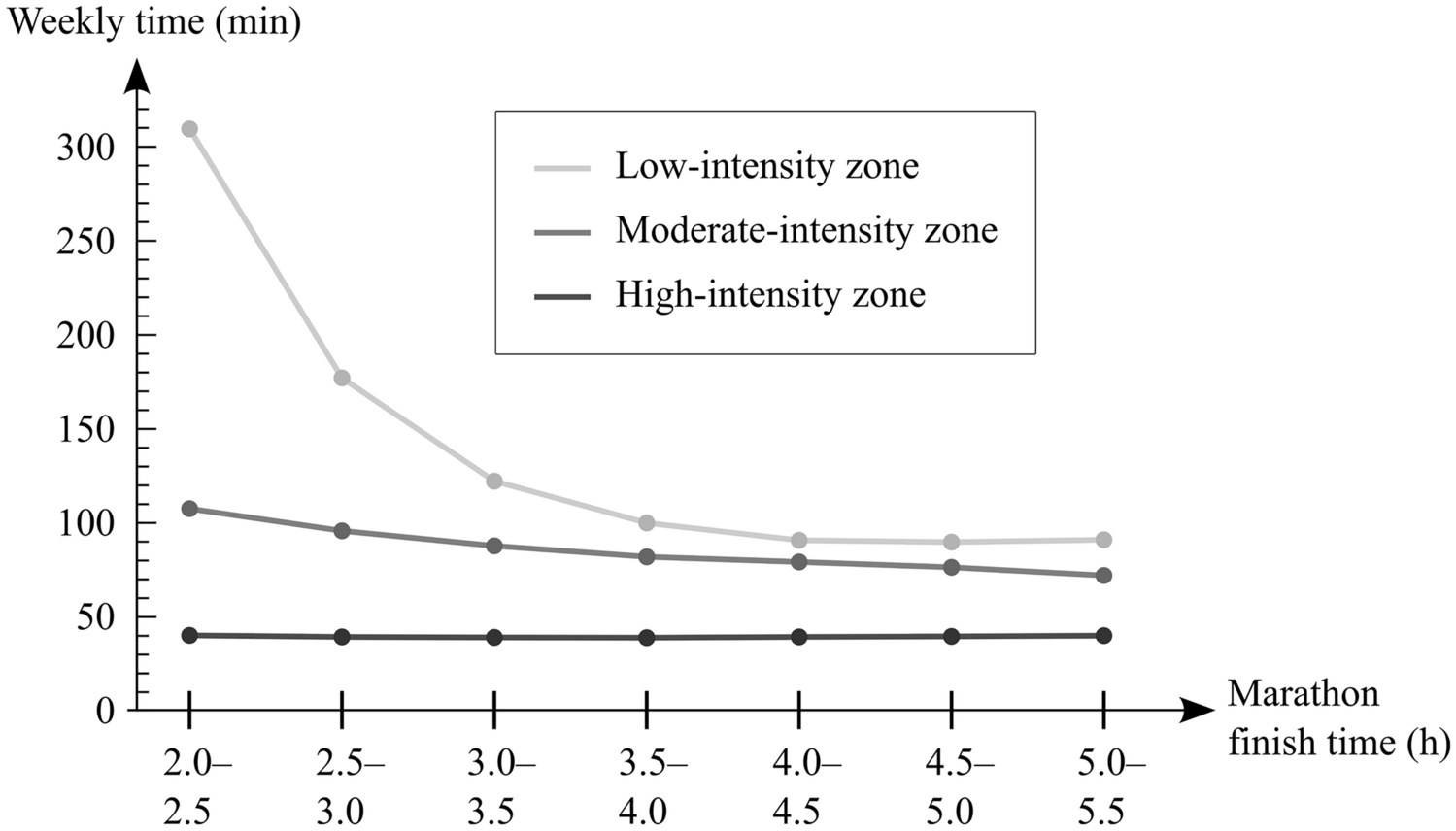
The most striking result: The faster the marathon finish time, the higher the proportion of training spent in Zone 1. More than 80% of the top runners followed a pyramidal model—high volume in Zone 1, moderate in Zone 2, and very little in Zone 3.
Why does it work? Physiological and psychological effects
A commentary by Matomäki et al. (2) offers several explanations for why endurance-focused training in Zone 1 is so effective. It lowers the risk of overuse injuries, enables higher training frequency, and positively affects energy efficiency and muscle fatigue over time. It also supports sustainable progression without constant mental strain from high-intensity efforts.
High-intensity sessions in Zone 3 still play a role. However, they should be applied strategically and built upon a solid aerobic foundation. The study provides strong data-based evidence that a high proportion of low-intensity endurance training is a key factor for long-term marathon success.
What this means for your training – and how Nemeko can support you
Whether you're preparing for your first race or looking to optimize your performance: if you want long-term progress, focus on structured training intensity distribution. But it's not just about pace—technique also matters in each intensity zone.
This is exactly where Nemeko comes in: The app analyzes your running form using video—accurately, quickly, and without any special equipment. All you need is your smartphone.
- • Step 1: Record a short video of yourself running at your desired training intensity (Zone 1, 2, or 3) using your smartphone.
- • Step 2: Upload the video to the Nemeko app.
- • Step 3: In less than a minute, you'll receive a detailed analysis of your running form: cadence, joint angles, movement patterns, and strengths and weaknesses.
Nemeko gives you a data-driven foundation to align training volume, intensity, and technique in a meaningful way.

Sources:
1) Belinchón‑deMiguel, P., García‑Pinillos, F., Jurov, I. et al. (2025). The Training Intensity Distribution of Marathon Runners Across Performance Levels. Sports Medicine, 55(4), 1023–1035. DOI: 10.1007/s40279-024-02137-7
2) Matomäki, P. Eur J Appl Physiol (2025). Why low-intensity endurance training for athletes?. European Journal of Applied Physiology, 55(4), 1023–1035. DOI: 10.1007/s00421-025-05843-w