
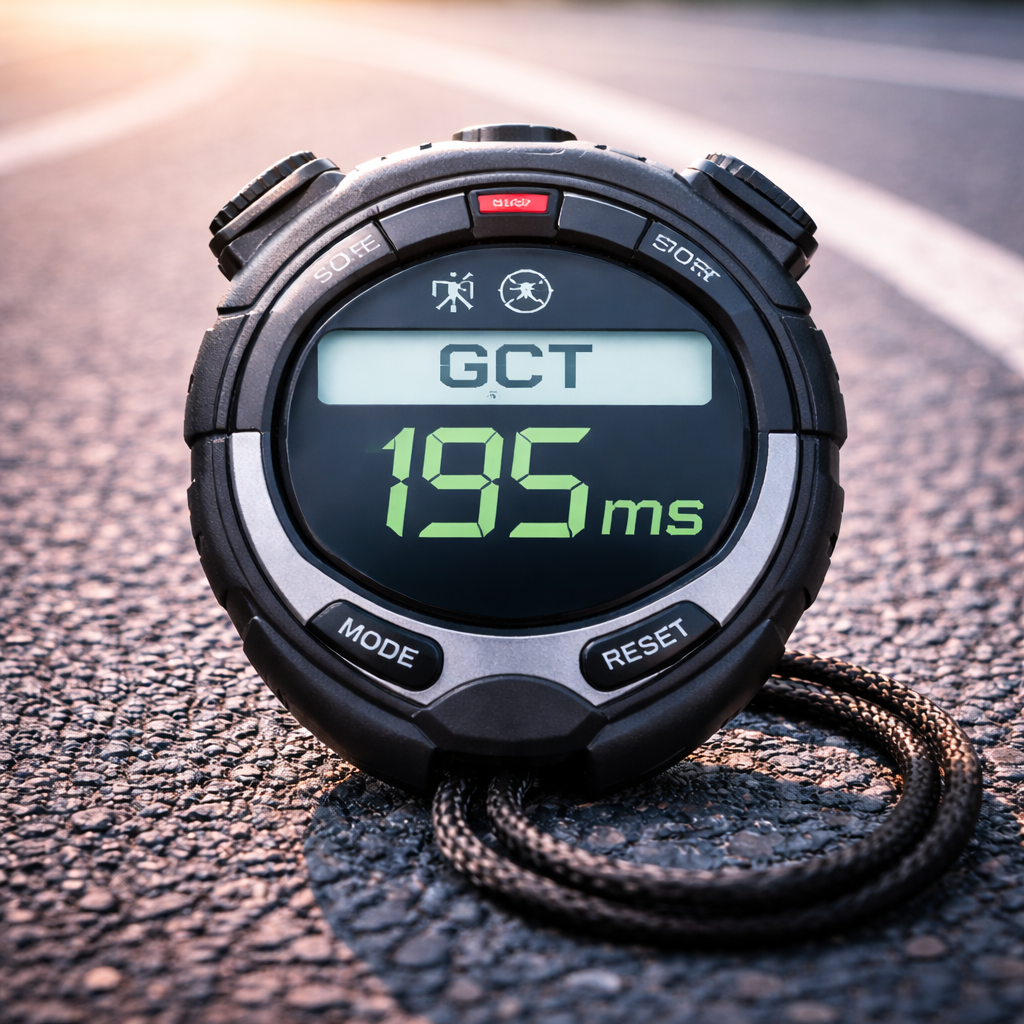
When running, our feet are in contact with the ground for a brief moment with every step. Ground Contact Time, or GCT, describes exactly this phase: from the initial foot strike to toe-off.
It is measured in milliseconds and can reveal a great deal about how efficiently we run.
What happens during ground contact?
The ground contact phase is not just a passive “roll-through”. It is a decisive moment in which the body has to perform several tasks at once. Impact forces are absorbed, elastic energy is stored in muscles and tendons, and then released again to generate forward propulsion. How well this process works has a major influence on running economy and speed.
Ground Contact Time provides insight into your running mechanics.
Ground Contact Time and running economy
Biomechanical research shows a clear pattern: as running speed increases, ground contact time decreases. This is not because faster runners “try to get off the ground quicker”, but because they are able to produce higher forces in a shorter time. Their legs behave like efficient, well-tensioned springs.
It is important to understand that a short GCT is the result of effective force transmission – not its cause.
Ground Contact Time cannot be deliberately “shortened”. Instead, it usually changes as a by-product of other adaptations. For this reason, it makes sense to look at the factors that can influence it.
Stable hip and core musculature helps to use energy more efficiently during ground contact. In a more “sitting” running style, where the hips and knees yield noticeably during the stance phase, part of this energy is lost. This can delay toe-off and unintentionally increase the time spent on the ground. Strength and coordination training do not offer quick fixes, but can create the long-term foundations for a more stable and reactive running style.
Cadence can be another influencing factor. A very low step rate increases the likelihood of overstriding (landing with the foot far in front of the centre of mass) which is often associated with longer ground contact times.
Ground Contact Time should therefore be seen as a complementary indicator that needs to be interpreted in the context of a full running analysis. Nemeko helps to make visible what actually happens during the ground contact phase, allowing you to identify where there is still potential for improvement.